
Read time: 6 minutes
Highlights
The food industry is entering a new era where AI no longer just suggests ideas but autonomously executes entire R&D cycles.
- The Agentic Shift: Moving from “suggestive” Gen AI interns to “agentic” AI executors that can book, buy, and build.
- The R&D Powerhouse: A new workflow that identifies market whitespaces, checks FSANZ/FDA compliance, and sources ingredients without human intervention.
- The Platform War: The competition between MattsonIQ’s “culinary soul” and NTT DATA’s “enterprise orchestrator” to become the brain of food companies.
- Strategic Lock-in: How data moats and Answer Engine Optimisation (AEO) are becoming the new competitive advantages for manufacturers and suppliers.
Are you tired of AI just “suggesting” things?
For the last couple of years, we’ve been playing with Generative AI like it’s a very talented, slightly erratic intern. It’s great at brainstorming five ways to use pea protein or drafting a marketing blurb for a new keto snack. But when it comes to actually doing the work, it stops at the finish line… waiting for us to take over.
Well, that’s all changing right now!
We’re moving from the era of “Chatbots” to the era of “Agents.” This isn’t just a small step; it’s a massive, disruptive leap that’s going to redefine how every food and beverage company on the planet operates. Let’s look at how this “Agentic R&D Revolution” is unfolding and why the battle for the “brain” of your company has already begun.
The Agentic Leap: From Brochure to Booking
To understand the difference between the AI we’ve had and the AI that’s arriving, just think about a travel agent for a minute.
Generative AI is like a travel agent who shows you a beautiful brochure of Fiji. It’s inspiring, the pictures are great, and it gives you a list of hotels. But then it hands the brochure to you and says, “Good luck booking the flights and the accommodation yourself.”
Agentic AI, on the other hand, is the travel agent who doesn’t just show you the brochure. It knows your budget, it knows you hate middle seats, it knows you’re allergic to shellfish… and it goes ahead and books the flights, reserves the villa, and handles the travel insurance.
In the food world, this means AI that doesn’t just “suggest” a recipe; it actually executes the workflow. It’s the difference between a suggestion and a solution.

The Autonomous R&D Scenario
Imagine you’re a product developer at a major brand. In the old world, a new product could take eighteen months to get from an idea to a shelf. But in this new agentic world, your AI agent is already working while you’re asleep.
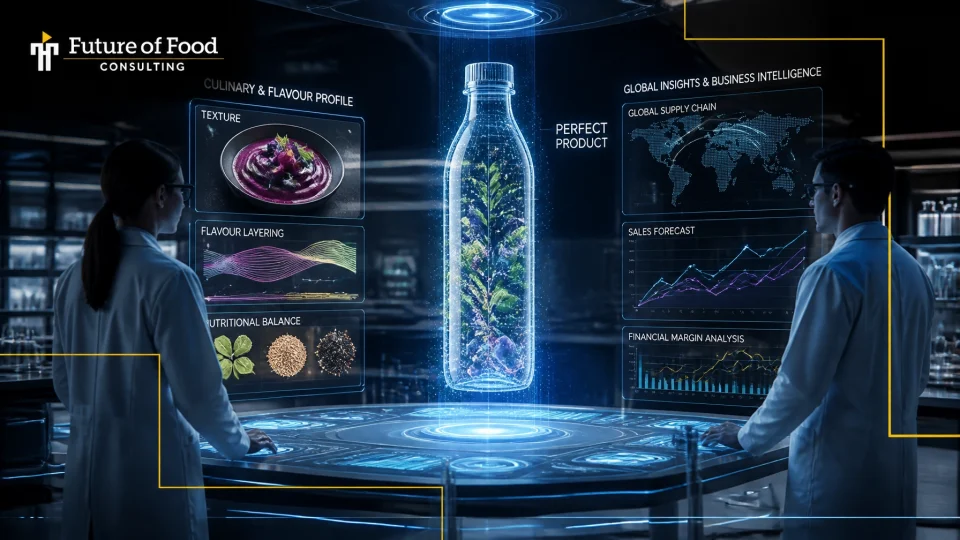
It starts by scanning global market data to find “whitespaces” where consumer demand is high but competition is low. It then formulates a new beverage concept, instantly checking it against FSANZ (Food Standards Australia New Zealand) or FDA regulations to ensure every ingredient is compliant.
But it doesn’t stop there. The agent then logs into a B2B ingredient platform, requests samples from suppliers, and organises for them to be delivered to your lab by Tuesday.
This isn’t science fiction… it’s the new standard for speed and resilience in our food system. If you’re not moving at this pace, you’re going to find it very difficult to compete with those who are.
The Battle for the Brain: MattsonIQ vs NTT DATA
As this technology matures, we’re seeing two very different types of “AI brains” emerging. I call this the “Battle for the Brain,” and it’s a choice every food leader will have to make soon.
On one side, we have MattsonIQ, which I describe as the “Culinary Soul.” Developed by the legendary product developers at Mattson in partnership with the Culinary Institute of America, this platform is built on decades of deep food science and culinary expertise. You can read more about their AI Lab here. It’s designed for the creators, the chefs, and the food scientists who want an agent that understands the nuance of flavour and texture.
On the other side, we have NTT DATA, the “Enterprise Orchestrator.” They’ve recently launched an AI agent service specifically for the food and CPG industry that’s all about scale and automation. NTT DATA’s approach focuses on sales forecasts, visual concept imagery, and integrating with your entire corporate infrastructure.
Is this a choice between the “Artist” and the “Engineer”? Both are incredibly powerful, but they represent very different strategic paths for your R&D department.
Strategic Moats and the Rise of AEO
This shift brings up a concern for many organisations, and that’s the idea of “Strategic Lock-in.”
When you choose an agentic platform, you aren’t just buying software; you’re feeding it your proprietary data, your brand guidelines, and your successful “gold standard” formulations. This creates a massive data moat. The more the agent learns about your specific way of working, the more “locked in” you become to that platform.

And for the ingredient suppliers listening… there’s a new game in town called Answer Engine Optimisation (AEO).
In the past, you focused on SEO so that people could find your website. But in a world of agentic AI, it’s the agents who are doing the searching. If your ingredient data isn’t structured in a way that an AI agent can understand, your product won’t even be “suggested” for the next big formulation. You need to ensure you’re the “answer” that the AI agent is looking for.
It’s amazing how fast these digital gatekeepers are changing the rules of the game!
Speed and Resilience as the New Currency
As we look toward 2027 and beyond, the currency of the food industry is no longer just “quality” or “brand heritage.” It’s speed and resilience.
The ability to pivot a product line in days rather than months is what will separate the winners from the losers. Whether it’s responding to a sudden supply chain disruption or a lightning-fast consumer trend, agentic AI is the engine that makes that agility possible.
Just think about this for a minute… what would happen to your business if your biggest competitor could launch three new products in the time it takes you to hold one planning meeting?

You’re in trouble if you’re still relying on manual spreadsheets and “suggestive” tools in an autonomous world. It’s time to decide which “brain” is going to lead your innovation.
Helping companies navigate these exact disruptions is what I do. If you’re ready to move from suggestion to execution, I’d love to help you map out your future.
To continue the conversation email me at tony@futuristforfood.com
Join the Conversation
If you’re interested in hearing me speak more about these transformations, please check out my upcoming speaking events at https://www.tonyhunterspeaker.com/events/.
I’m also delighted to help businesses navigate these existential threats through my proprietary FutureCUBED™ process. Let’s transform these disruptions into your greatest strategic opportunities!
For more insights on how technology is reshaping our industry, you might find my recent post on the impact of cheap energy on food production quite interesting.
