
Read time: 5 minutes
Highlights
Microbiome modelling could help food brands move from population averages to products designed for different biological responses.
- The shift: Digital twin microbiomes use computer models to simulate how someone’s gut bacteria might respond to a food or supplement.
- The commercial signal: Early research suggests people don’t all respond to the same prebiotic or probiotic in the same way.
- The opportunity: Future food products could be matched to microbiome profiles, but the science still needs validation.
- The strategic move: Food leaders can start considering the data, partnerships and evidence needed for more personalised nutrition.
The future of food trends 2027 may include something extraordinary at the breakfast table, a computer simulation that estimates how your gut bacteria could respond before you eat. That’s the promise behind digital twin microbiomes, and it could change what personalised nutrition means for food companies.
I’ve written before about immune system digital twins. This is a different biological focus. Instead of modelling immune responses, researchers are beginning to model the busy community of microbes living in the gut.
What’s a digital twin microbiome?
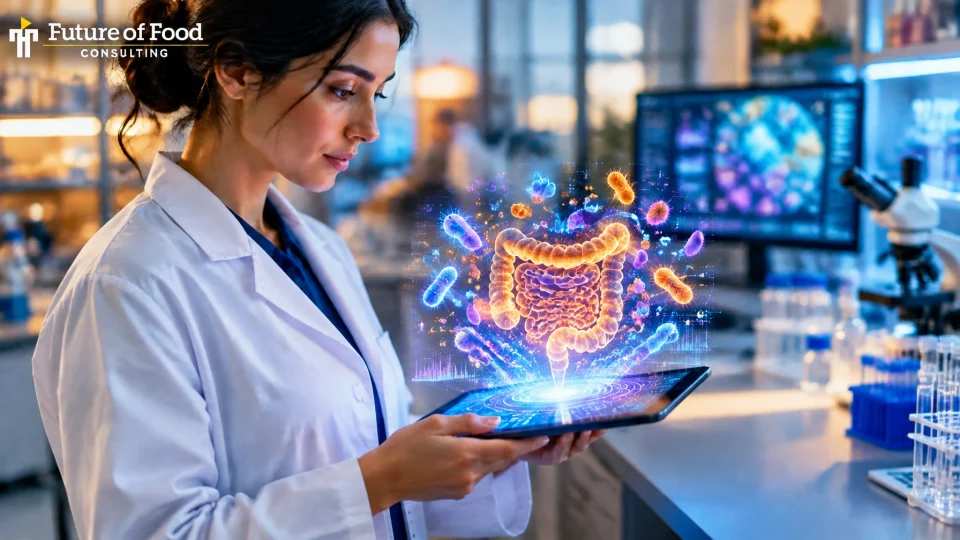
A digital twin microbiome is a computer model built using information about someone’s gut bacteria, diet and health. It’s designed to simulate how that microbial community might respond to a particular food, prebiotic, probiotic or, in some research, a medicine.
Think of it as a way to ask “what if?” before making a real-world change. What if this person ate more fibre? What if they tried a particular prebiotic? How might a probiotic interact with the microbes already present?
The aim isn’t to create a perfect virtual copy of someone’s gut. It’s to make a useful prediction about how the system might respond. That difference is important. We’re talking about models that could help narrow down options, not a crystal ball that can guarantee a health outcome.
A January 2026 study explored how computer modelling could examine interactions between diet, gut bacteria and metformin in people with prediabetes. A February study took a closer look at why prebiotic and probiotic treatments may work for some people and not others. And an August review described the wider movement towards using gut microbiome twins for predictive health modelling.
Together, these are important signals for future of food trends 2027. They suggest that researchers are starting to explore not just what’s in someone’s gut, but how that ecosystem might react to an intervention.
The commercial question behind probiotics
For food and supplement companies, the central issue isn’t simply whether a product contains a probiotic or prebiotic. It’s whether it’s likely to work for the person buying it.
That’s a difficult question. A product can be designed with a promising ingredient and still deliver different results across different people. If the gut environment, diet and existing microbes vary, a standard formulation may not suit everyone.
A 2026 PLOS Biology study examined computer models using data from human intervention trials. The researchers found that the models’ predictions of whether probiotic microbes would grow in a person’s gut broadly aligned with observed outcomes across two trial datasets. The study also reported substantial person-to-person variation in predicted responses to dietary fibre.
That’s an encouraging step, but a computer model can’t yet choose the right product for every individual. It does, however, offer a compelling reason to investigate why a treatment might work for one person and not another.
For brands, this could turn personalised nutrition from a marketing promise into a product-development question. Could we identify groups of consumers who respond differently? Could a model help our R&D team test ingredients and combinations more thoughtfully? And what evidence would we need before making a consumer-facing claim?

Future possibilities
Here’s where I think this could become fascinating. Imagine a supermarket app that compares your microbiome twin with products on the shelf and suggests which ones might best suit your profile. Or a food company developing three versions of the same yoghurt, each formulated for a different microbiome pattern. That's a level of personalisation a food company could handle.
Those scenarios aren’t everyday reality today. They’re possibilities that point towards a future in which food recommendations could be based on more than broad population averages.
In the next one to three years, I’d expect the action to centre on research, model development and clinical pilots. Food companies may work with researchers, health providers and technology partners to explore specific ingredients and consumer groups.
Over three to five years, we could see early commercial products described as simulated for particular microbiome profiles. The most credible companies will be those that explain what their models can predict, share where uncertainty remains and build a strong evidence base before making bold promises.
Looking further ahead, perhaps five to ten years or more, microbiome twins could become a routine part of health infrastructure, much as blood tests are today. Food companies might formulate for broad microbiome segments rather than attempting to create a unique product for every individual. Hospitals and insurers could eventually explore gut models as one input into tailored dietary support.
I’m also interested in the intersection between the microbiome and AI. The Microbiome is one of the five technologies in my TECHXponential™ model alongside Alternative Proteins, Cellular Agriculture, Genomics and Synthetic Biology. AI is one of its four accelerators, alongside Energy, Quantum Computing and Sensors. Together, they could help researchers make sense of complex biological information and translate it into more useful predictions.
For a wider systems view of genomics, microbiome science and AI in precision nutrition, see my article on The Triad of Transformation.
At the moment this is a strategic horizon to explore, not a finished product category. In my FutureCUBED™ process, that means scanning the signals, testing multiple possible futures and identifying practical moves that keep options open. Leaders can begin by asking what data they already have, which partnerships could help fill the gaps and how they’ll distinguish evidence-led personalisation from a clever label.
The future of food trends 2027 may be less about selling a single “good for your gut” product and more about understanding who it’s good for, and why. The leaders who start asking that question now could be better placed as microbiome modelling moves from research into product development.
So here’s the question I’d put to food, beverage and agriculture leaders. If you could simulate how a product might work for different consumers before launch, what would you change about your next innovation pipeline?
To continue the conversation email me at tony@futuristforfood.com
