
Read time: 6 minutes
Highlights
Almost 50 ship attacks in a month show how quickly an efficient food trade route can become a source of strategic risk.
- The warning is live: Nearly 50 vessels attacked in October, a ship capsized off Romania, and Ukrainian grain exports are squeezed, but a global price shock hasn’t landed.
- Efficiency has a blind spot: A supply system optimised for cost can struggle when its main route is threatened.
- Biomanufacturing can add a hedge: Local fermentation capacity can reduce reliance on maritime routes for some proteins, fats and food ingredients.
- Energy matters: The Fourth Engine of energy is essential to making distributed biomanufacturing viable.
- Risk is rising, not landed: Global grain reserves are stronger than in 2022, and that distinction matters.
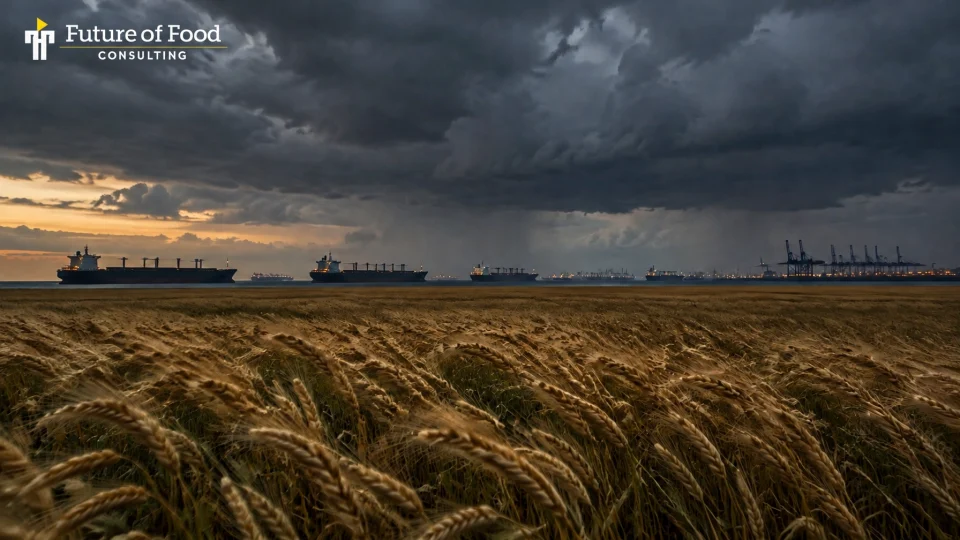
Nearly 50 commercial vessels attacked in a single month. That’s the stark signal from the Black Sea.
On 20 October, EU foreign policy chief Kaja Kallas warned that suspected Russian drone strikes on civilian shipping are deepening what she called a “perfect storm” for world food supplies. Ukraine is losing around EUR 60 million a day in export revenue, and the strikes have hit ships off Romania and Bulgaria, both EU and NATO members.
The escalation has continued since. On 23 October, the Comoros-flagged cargo vessel Khoryv was struck by a drone around 13 nautical miles off Romania’s Constanța port. The ship caught fire and capsized, one sailor was killed, three are still missing and nine were rescued. Romania’s President Nicușor Dan called it “a new example of the tragic consequences of Russia’s aggression against Ukraine”, and European Commission President Ursula von der Leyen said she was “deeply alarmed by yet another Russian escalation in the Black Sea”.
Maritime analysts report that nearly 50 commercial vessels have been attacked in the Black Sea during October alone, with at least 31 seafarers dead or missing across the month. Romanian F-16s have even shot down drones over the sea. What began as an intensifying risk is now being described as the deadliest shipping route in the world, and it borders two EU and NATO member states.
This isn’t a prediction that wheat prices are about to surge. It’s a warning that the wheat supply chain is becoming more exposed at a moment when drought, a super El Niño and conflict in the Middle East are also putting pressure on food and fertiliser supplies.
In her address to the European Parliament, Kallas also made an important qualification. Global grain reserves are in better shape than they were in 2022, when a Russian blockade left 20 million tonnes of Ukrainian grain stranded. That gives the world more room to respond. But it doesn’t make the risks disappear.
When a key route comes under pressure
Ukraine is a major exporter of wheat, maize and barley, with most of those exports normally travelling by sea. When a vital route is disrupted, the effect isn’t limited to the ships directly affected. Exporters, buyers, insurers and logistics providers all have to reconsider whether cargo can move, where it can go and how long the journey will take.
As Euronews reports, the European Union’s overland solidarity lanes, developed after 2022, are also facing threats as Russia targets border crossings with Moldova, Romania and Poland. NATO says it’ll send additional assets for surveillance, reconnaissance and forensics.
Those measures are important. But alternative routes don’t necessarily have the capacity, speed or cost profile of the route they’re meant to support.
EUobserver reports that Ukraine exported only 20 percent of the grain it shipped in the same period the previous year in August. Its Danube route, which moves cargo through Romania’s Constanța port, has faced low water levels, congested terminals and drone attacks. Vessel waiting times have exceeded two weeks.
Russia is also adapting. Farm Online reports, in analysis by grain analyst Andrew Whitelaw of Episode 3, that Russia is moving more grain through Baltic ports despite southern port closures. Russian wheat exports have reached 2.8 million tonnes for October, with roughly 65 percent of shipments expected to move through northern ports. That rerouting has helped keep Russian exports flowing and eased some of the upward pressure on global wheat prices, which is part of why the market hasn’t broken.
That’s the wheat supply chain under real pressure. Not necessarily broken, but forced to work harder, with less certainty and fewer easy alternatives.
The counter-argument to efficiency
For years, food businesses have pursued efficiency through scale, specialisation and reliable access to global trade. There’s a good reason. Efficient systems can reduce costs and make food more affordable.
But efficiency has a blind spot when it assumes the route, supplier or energy source will always be available.
A supply network can look robust because it moves large volumes at low cost during normal conditions. Then a shipping lane is threatened, an insurance premium changes or a key port becomes difficult to use. Suddenly, the cheapest system has little room to absorb disruption.
This is why the Black Sea matters beyond the grain itself. It’s a live stress test of how much resilience the global food system can call on when a critical route comes under pressure.
I laid out the broader Board-level case in my piece on food security as national security. This latest event gives that argument a practical, immediate example. It shows what happens when geopolitical risk moves from a scenario on a slide to a constraint on ships, cargoes and export earnings.
Biomanufacturing as a different kind of hedge
Here’s the strategic connection food leaders need to consider. Every biomanufacturing plant can be a hedge against this kind of chokepoint.
That doesn’t mean a fermentation facility can replace Ukraine’s wheat exports. It can’t. Wheat is a staple, and precision fermentation isn’t a direct substitute for global grain production.
But facilities that produce proteins, fats and other ingredients locally can reduce reliance on maritime shipping for some parts of the food system. If a company can make a critical ingredient closer to its market, it may be less exposed to a particular export corridor, port or shipping disruption.

This is not resilience for free. Biomanufacturing still depends on suitable feedstocks, equipment, skilled operators and reliable infrastructure. It also needs energy at a competitive cost. If electricity is expensive or unstable, local production may simply trade one vulnerability for another.
That’s why I see the Fourth Engine, Energy, as central to the biomanufacturing opportunity. The next generation of food production won’t be defined only by what biology can make. It’ll also depend on whether businesses can power production reliably and affordably.
The bigger possibility is a more distributed system. Not every ingredient needs to be produced everywhere. But some strategically important products may be made closer to demand, alongside conventional agriculture and international trade. That kind of capacity can give food businesses another option when a shipping route is disrupted.
China’s numbers show why dependency matters
The same strategic question appears in China’s food system, although the issue there isn’t the Black Sea alone.
Systemiq’s China’s Food Future report describes a country with significant exposure to imported agricultural inputs. China imports about 84 percent of its soybeans, with more recent figures putting the share around 90 percent. It also imports 32 percent of its beef and runs an annual agricultural trade deficit of USD 124.5 billion.
At the same time, China’s self-sufficiency in rice, wheat and corn is above 90 percent. Systemiq projects that targeted changes could reduce China’s soybean imports by 25 percent by 2030.
Those figures aren’t a case for replacing trade. They show why a country might look at where it’s most exposed and consider how domestic capability, new technology and demand changes can provide more options.
The same logic applies to businesses. The question isn’t whether to abandon global supply. It’s whether your strategy gives you alternatives when one important route or input becomes harder to access.
Future possibilities
What if the next generation of food businesses planned for both efficient trade and local production capacity? What if a disruption to one maritime corridor didn’t immediately leave a company searching for its only available alternative?
That future won’t arrive all at once. It’ll depend on investment, energy costs, regulation and the economics of producing ingredients at scale. But the opportunity is already worth examining.
With wheat the supply chain is under pressure, but a price shock hasn’t landed; yet. Grain reserves are better than they were in 2022. The honest conclusion is that the risk is rising, not that the worst case is inevitable.
For food leaders, the challenge is to build resilience before it’s urgently needed. Efficiency still matters. But efficiency without options can become a vulnerability.
To continue the conversation email me at tony@futuristforfood.com
