
Read time: 4 minutes
Highlights
A new Indian facility points to a more practical path for scaling fermentation, built around existing agricultural resources.
- A different kind of plant: Brevel and The Wave Group are combining light and sugar-fed fermentation.
- Infrastructure matters: The first phase is planned for 100,000 litres, with the site designed for 300,000 litres.
- Location is strategic: The facility will use byproducts from an adjacent sugar mill.
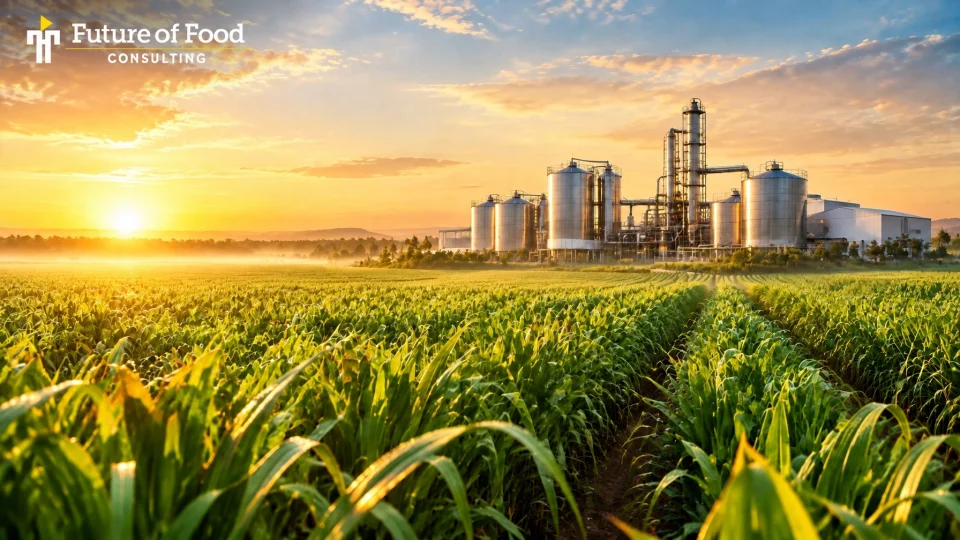
India’s first major illuminated fermentation plant is a signal worth watching. For leaders tracking precision fermentation, the story isn’t simply about another big bioreactor. It’s about placing production beside an existing sugar mill and using its byproducts as part of the production system.
Israeli startup Brevel and Indian conglomerate The Wave Group have formed a 50/50 joint venture to build the facility in Uttar Pradesh. The site is designed for 300,000 litres, with an initial 100,000-litre phase. Construction is expected to begin later in 2026, with production targeted during 2028. AgFunderNews reports on the joint venture.
What’s illuminated fermentation? In plain English, it combines light with sugar-fed fermentation in one process. Microorganisms receive sugar as a food source, while carefully managed light supports the production of useful compounds. Brevel says its approach can achieve yields far higher than light-based cultivation alone. The underlying idea is easy to grasp. Bring two production methods together and you may unlock a different balance of output, quality and cost.
Greenfield in location, brownfield in logic
The project has been described as a greenfield facility. But its strategic logic is distinctly brownfield. It’s being built beside an existing agricultural operation, not in isolation from one.
The Wave Group’s adjacent sugar mill offers a potential supply of molasses, raw sugar and sucrose-rich intermediates. Brevel says it’s testing these inputs and that early results show meaningful cost reductions. The direction is compelling. An input that might otherwise be underused could help feed a new manufacturing platform.
As I say, “waste is just a lack of imagination!”

That co-location reduces the need to transport feedstock over long distances. It also ties the facility’s future to the operations and supply of its neighbouring mill. This isn’t a neat circular-economy story just because waste streams are involved. The real test will be whether the material is consistent, affordable and available in the volumes the process needs.
The economics are just as interesting. The first 100,000-litre phase is expected to cost around US$10–15 million, with the building and basic utilities excluded from the joint venture investment and covered by The Wave Group. Brevel also designs and builds its own illuminated fermenters, rather than buying them from specialist equipment suppliers.
That model helps keep costs down. It’s a striking contrast with the USD 80–300 million planning range for new 50,000- to 200,000-litre commercial facilities discussed in my article on biomanufacturing infrastructure and retrofits. However, it’s not a like-for-like comparison. The Indian project excludes important site costs, and the processes and facilities may differ. Still, the question leaders should ask is clear. What can be made more affordable by designing around infrastructure that’s already there?
Brevel’s first product is Purallis, a whole-cell chlorella biomass containing protein, lutein, zeaxanthin, vitamin B12, fibre and fatty acids. The company also plans to make facility capacity available to plant cell culture businesses. Its proposed scale-up route is to develop production in Israel, then transfer processes to India for larger volumes. Brevel says the platform already has interested users and is pursuing future offtake agreements.
A different map for the capacity race
For anyone mapping precision fermentation India now sits beside the UAE on the industrial fermentation map. This story adds a new geography to that conversation. I’ve previously looked at the UAE’s exploration of large-scale food and agriculture capacity in Abu Dhabi. Uttar Pradesh represents a different model. Rather than building around a desert food-security strategy, this project is organised around an existing sugar industry and its potential feedstocks.
The broader thesis isn’t that every region needs the same facility. It’s that precision fermentation capacity may become more global, modular and locally adapted. One place might build around renewable energy, another around a sugar mill, an existing factory or a specialised workforce. The future could involve a network of production sites, not a few distant mega-plants. This approach could be favoured to assist with many countries’ food sovereignty, given the supply chain crises we’ve seen in recent times.
This is the kind of signal I examine through my FutureCUBED™ process, connecting emerging developments with alternative futures and practical strategic choices. For food businesses, the question isn’t only who has the most exciting technology. It’s who can secure the feedstock, equipment, skills, customers and operating environment needed to use that technology reliably.
Future possibilities
If the facility works as planned, it’ll show how a relatively modest first phase can establish a platform for later expansion. It may also give other ingredient companies access to production capacity without each one having to build a large site from scratch. That changes how businesses think about the cost and location of future manufacturing.
As illuminated fermentation moves into a sugar-mill setting, will other food and agriculture businesses start seeing their existing byproducts and facilities as the foundations of tomorrow’s biomanufacturing?
To continue the conversation email me at tony@futuristforfood.com
